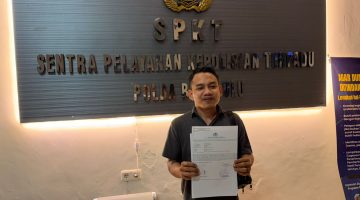










Bireuen, Aceh — MediaViral.net
Indonesia’s Free Nutritious Meal Programme (MBG), a flagship policy under the leadership of Prabowo Subianto, is rapidly emerging as one of the most consequential socio-economic transformations in the country’s modern era.
Far beyond a conventional welfare initiative, the programme is now being positioned as a strategic pillar for economic resilience and global competitiveness, with far-reaching implications for Indonesia’s future.

A Long-Term National Strategy, Not a Temporary Policy
Chairman of Volunteers Caring for People Across Borders (RPRLB), Arizal Mahdi, stressed that the programme must not be treated as a short-term intervention.
Instead, it should be institutionalised as a permanent national strategy—one that simultaneously strengthens grassroots economic stability and enhances Indonesia’s position in an increasingly competitive global landscape.
According to Arizal, the programme operates as a dual-force instrument:
A comprehensive social protection system, and
A driver of inclusive, people-centred economic growth
Massive Economic Impact and Multiplier Effect
Backed by an allocation of approximately IDR 71 trillion, the programme is projected to generate an additional IDR 14.61 trillion in economic output while opening hundreds of thousands of jobs across sectors.
Its design prioritises domestic supply chains, creating a powerful multiplier effect by directly engaging:
Farmers
Livestock producers
Small and medium-sized enterprises (SMEs)
Community-based service providers
This ecosystem does more than stimulate demand—it stabilises rural incomes and distributes economic activity more evenly nationwide.
At the macro level, the programme represents a targeted fiscal stimulus focused on lower-income groups, widely recognised as the backbone of sustainable economic growth.
Empowering SMEs and Strengthening Local Economies
A key strength of the MBG programme lies in its integration of SMEs and village-based enterprises into its operational framework.
Research from global institutions such as the World Bank consistently shows that locally anchored consumption policies:
Strengthen community resilience
Reduce inequality
Accelerate grassroots economic growth
Within this framework, the programme acts as:
A catalyst for informal sector expansion
A growth engine for small businesses
A stabiliser for regional economies
Aligned with Global Best Practices
Globally, large-scale nutrition and school feeding programmes have been implemented in over 100 countries, reaching around 466 million children, supported by institutions like the World Food Programme.
Countries such as:
Brazil
India
Kenya
have demonstrated that such initiatives:
Increase school attendance
Reduce household financial burdens
Strengthen local economic ecosystems
Indonesia is now moving decisively into this league—positioning itself as a serious contender in building an inclusive, resilient, and future-ready economy.
Direct Impact on Household Stability
Beyond macroeconomic indicators, the programme delivers immediate, tangible benefits at the household level:
Reducing daily food expenses
Ensuring access to proper nutrition
Increasing purchasing power
Strengthening financial security
These outcomes collectively reinforce social stability and long-term national resilience.
Governance Will Determine Success or Failure
Despite its enormous potential, Arizal issued a firm warning:
governance will be the decisive factor.
The programme must be implemented with:
Strict transparency
Accurate targeting
Continuous oversight
Without these safeguards, risks such as inefficiency, misallocation, and weakened impact could undermine its transformative potential.
A National Investment in the Future
“This programme is not merely a policy,” Arizal Mahdi concluded.
“It is a long-term national investment in Indonesia’s strength, dignity, and global competitiveness.”
(mediaviral.net)